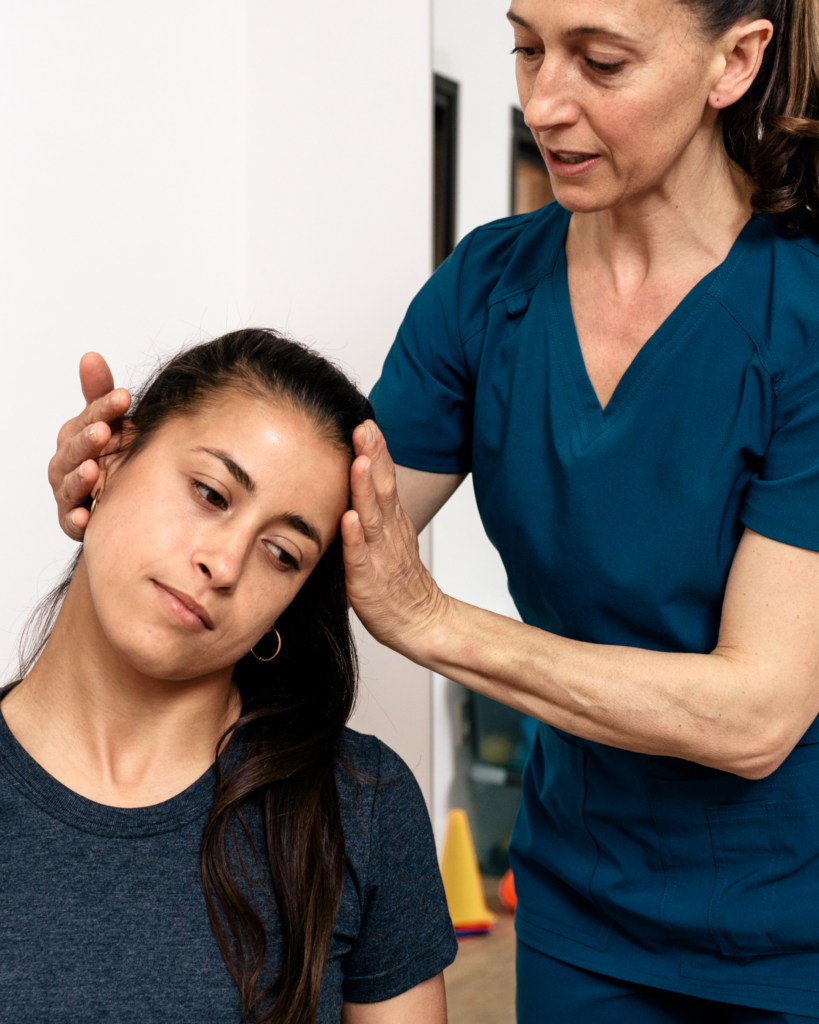
An estimated 1.6–3.8 million sport- and recreation-related concussions occur in the United States each year, and dizziness is among the most common symptoms after injury.[1–3] For vestibular clinicians, concussion is therefore a major part of practice—even when the referral simply says “dizziness.”
The field has moved well beyond “rest in a dark room until symptoms disappear.” Current evidence supports a short period of relative rest followed by early, symptom-guided activity, targeted rehabilitation, and a multimodal examination that addresses vestibular, ocular, cervical, exertional, motor, cognitive, and psychological contributors.[1,2]
Rest is no longer the default
The Amsterdam consensus recommends relative—not strict—rest during the first 24–48 hours.[1] Patients should reduce activities that significantly exacerbate symptoms while continuing basic activities of daily living and light physical activity as tolerated. Complete isolation, prolonged bed rest, and avoidance of all cognitive or physical activity are not recommended.
Screen use deserves specific attention. In a randomized trial of patients ages 12–25, those assigned to screen abstinence during the first 48 hours had a shorter median symptom duration than those allowed unrestricted screen use.[4] Current consensus therefore supports reducing screen exposure during this early period, especially when it provokes headache, dizziness, eye strain, nausea, or cognitive fatigue. This should not be interpreted as “cocooning.” Light walking can begin during the first 24–48 hours, and active, guided recovery should progress after that window.[1]
Mild, brief symptom exacerbation is acceptable. The consensus describes an increase of roughly no more than two points on a 0–10 scale that resolves within about an hour as a reasonable guide.[1] Randomized trials also support early subsymptom-threshold aerobic exercise during the first week, with faster recovery and less risk of persistent symptoms compared with stretching-based controls.[5,6]
Immediate removal from play matters as well. In one adolescent cohort, athletes who continued playing averaged about 44 days to recovery versus 22 days in those removed immediately, and later work demonstrated a dose-response relationship between continued play and longer recovery.[7,8]
For rehabilitation clinicians, 10 days is a useful milestone: Amsterdam recommends cervicovestibular rehabilitation when dizziness, neck pain, or headache persists beyond 10 days, and multimodal reassessment when symptoms are not progressively resolving over the first 2–4 weeks.[1]
Not every concussion presents the same way
Concussion is not one uniform presentation. Patients may show overlapping vestibular, ocular, cervical, migraine/headache, cognitive-fatigue, sleep, autonomic, and psychological features. Clinical-profile frameworks commonly describe vestibular, ocular, migraine, cognitive/fatigue, and anxiety/mood presentations, with cervical and sleep dysfunction as important modifiers.[9] These are best viewed as treatment-guiding frameworks rather than rigid diagnostic subtypes.
Early dizziness, post-traumatic migraine, and vestibulo-ocular dysfunction have all been associated with longer recovery in specific cohorts.[10–12] Even when dizziness is the chief complaint, the history should therefore address headache phenotype, migraine history, neck pain, vision, motion sensitivity, sleep, mood, cognitive fatigue, exercise intolerance, and relevant medical history.
Evaluation should be multimodal
Current guidance supports a multidomain assessment rather than reliance on a symptom checklist or single test.[1,2] For rehabilitation clinicians, that means examining cervical function, vestibular and oculomotor performance, balance and gait, exercise tolerance, and—when relevant—cognition, dual-task performance, sleep, and psychological factors.
Cervical findings are particularly important because the same mechanism that produces concussion may also load the cervical spine. Cervical dysfunction can contribute to headache, dizziness, and altered sensorimotor control and should be considered alongside vestibular findings.[2,13]
The Vestibular/Ocular Motor Screening (VOMS) remains a useful symptom-provocation screen for smooth pursuit, saccades, near-point convergence, VOR, and visual motion sensitivity.[14] VOR and visual motion sensitivity are often provocative, and a symptom increase around two points has commonly been used as a clinical cutoff. However, VOMS is a screen—not a complete vestibular examination or stand-alone diagnostic test. When used longitudinally, distance, speed, repetitions, and testing procedure should be standardized.
Also distinguish SCAT6 from SCOAT6. SCAT6 is primarily an acute sport-concussion assessment, while SCOAT6 was developed for office-based evaluation beginning roughly 72 hours after injury and through the subsequent weeks.[1,15]
And do not skip BPPV testing when the history is positional. Prospective concussion cohorts have reported BPPV rates ranging from about 9% to 22%, depending on population and setting.[16,17] Dizziness with rolling in bed, lying down, looking up, or getting out of bed deserves positional testing rather than being attributed automatically to “the concussion.”
Treatment: integrate, don’t isolate
The strongest practical message is to match rehabilitation to the impairments identified. For many patients, more than one system needs treatment at the same time.[1,2,13]
Vestibular/ocular rehabilitation may include gaze stabilization, habituation, balance and sensory-integration training, oculomotor work when indicated, and canalith repositioning for BPPV. Progress exercises to keep reaching each individuals challenge point reaching only mild symptoms provocation: integrate head movement, walking, visual complexity, dual-tasking, work demands, and sport-specific tasks.
Aerobic rehabilitation should be individualized and progressive. The Buffalo Concussion Treadmill Test can identify symptom-limited exercise tolerance and guide heart-rate prescription.[1,5,6] Cycling protocols can also be useful when balance, gait, orthopedic limitations, or safety make treadmill testing inappropriate.[18]
Cervical rehabilitation may include mobility, sensorimotor retraining, deep-neck-flexor/extensor endurance, scapular and thoracic strengthening, and manual therapy when indicated. In a randomized trial of patients with persistent dizziness, neck pain, and/or headache, adding cervical and vestibular rehabilitation improved Agility training with cognitive challenges also matter after symptoms improve. Athletes have an elevated musculoskeletal injury risk after return to sport, with meta-analyses reporting approximately 1.6 times the risk of lower-extremity injury or about twofold greater odds of subsequent musculoskeletal injury.[19,20] Residual reaction-time, postural-control, divided-attention, and neuromuscular deficits may contribute. Agility, reactive movement, landing mechanics, cognitive-motor dual-tasking, and sport-specific decision-making can therefore be appropriate later-stage targets. A small randomized trial also found fewer subsequent injuries after an eight-week neuromuscular training program in youth athletes after return-to-play clearance.[21]
Dose and messaging matter
The goal is not symptom avoidance. It is appropriately dosed exposure that produces adaptation without prolonged or excessive exacerbation. Ask how much symptoms increase, how quickly they return toward baseline, whether performance is improving, whether the patient tolerates increasingly complex environments, and whether they are under- or over-performing the prescribed dose.
Communication is also part of treatment. Fear avoidance, catastrophizing, and negative recovery expectations are associated with greater symptom burden and persistent symptoms.[22–24] That does not mean persistent symptoms are “psychological”; it means biological, vestibular, cervical, autonomic, cognitive, behavioral, and psychological factors interact.
Patient education should reinforce that mild, brief symptoms during appropriately prescribed activity do not necessarily indicate harm, avoidance is not the same as protection, and activity can be progressively restored. For selected patients with persistent symptoms, cognitive behavioral therapy and psychologically informed rehabilitation may also improve outcomes.[25]
The takeaway
Modern concussion rehabilitation is active, individualized, and multidisciplinary. Use relative rest and reduced screen exposure during the first 24–48 hours, then transition toward guided activity and aerobic exercise. Test for BPPV when indicated, and treat cervical, vestibular, ocular, exertional, motor, and psychological contributors according to the patient’s presentation.
For vestibular specialists, gaze stabilization, habituation, visual-motion exposure, balance training, BPPV management, aerobic exercise, and dual-task progression are not side notes in concussion care. They are central components of evidence-based rehabilitation.
References
- Patricios JS, Schneider KJ, Dvorak J, et al. Consensus statement on concussion in sport: the 6th International Conference on Concussion in Sport—Amsterdam, October 2022. Br J Sports Med. 2023;57:695–711.
- Quatman-Yates CC, Hunter-Giordano A, Shimamura KK, et al. Physical Therapy Evaluation and Treatment After Concussion/Mild Traumatic Brain Injury. J Orthop Sports Phys Ther. 2020;50(4):CPG1–CPG73. doi:10.2519/jospt.2020.0301.
- Gianoli GJ. Post-concussive dizziness: a review and clinical approach to the patient. Front Neurol. 2022;12:718318.
- Macnow T, Curran T, Tolliday C, et al. Effect of screen time on recovery from concussion: a randomized clinical trial. JAMA Pediatr. 2021;175(11):1124–1131. doi:10.1001/jamapediatrics.2021.2782.
- Leddy JJ, Haider MN, Ellis MJ, et al. Early subthreshold aerobic exercise for sport-related concussion: a randomized clinical trial. JAMA Pediatr. 2019;173(4):319–325. doi:10.1001/jamapediatrics.2018.4397.
- Leddy JJ, Master CL, Mannix R, et al. Early targeted heart rate aerobic exercise versus placebo stretching for sport-related concussion in adolescents: a randomised controlled trial. Lancet Child Adolesc Health. 2021;5(11):792–799.
- Elbin RJ, Sufrinko A, Schatz P, et al. Removal from play after concussion and recovery time. Pediatrics. 2016;138(3):e20160910.
- Charek DB, Elbin RJ, Sufrinko A, Schatz P, D’Amico NR, Collins MW, Kontos AP. Preliminary evidence of a dose-response for continuing to play on recovery time after concussion. J Head Trauma Rehabil. 2020;35(2):85–91.
- Kontos AP, Sufrinko A, Sandel N, Emami K, Collins MW. Sport-related concussion clinical profiles: clinical characteristics, targeted treatments, and preliminary evidence. Curr Sports Med Rep. 2019.
- Lau BC, Kontos AP, Collins MW, Mucha A, Lovell MR. Which on-field signs/symptoms predict protracted recovery from sport-related concussion among high school football players? Am J Sports Med. 2011.
- Kontos AP, Elbin RJ, Lau B, et al. Posttraumatic migraine as a predictor of recovery and cognitive impairment after sport-related concussion. Am J Sports Med. 2013.
- Master CL, Master SR, Wiebe DJ, et al. Vision and vestibular system dysfunction predicts prolonged concussion recovery in children. Clin J Sport Med. 2018;28(2):139–145.
- Schneider KJ, Meeuwisse WH, Nettel-Aguirre A, et al. Cervicovestibular rehabilitation in sport-related concussion: a randomised controlled trial. Br J Sports Med. 2014;48(17):1294–1298. doi:10.1136/bjsports-2013-093267.
- Mucha A, Collins MW, Elbin RJ, et al. A brief Vestibular/Ocular Motor Screening (VOMS) assessment to evaluate concussions: preliminary findings. Am J Sports Med. 2014;42(10):2479–2486. doi:10.1177/0363546514543775.
- Schneider KJ, et al. Beyond acute concussion assessment to office management: a systematic review informing the development of a Sport Concussion Office Assessment Tool (SCOAT6) for adults and children. Br J Sports Med. 2023;57.
- Burrows L, et al. Rate of BPPV in patients diagnosed with concussion. J Head Trauma Rehabil. 2023.
- Covert K, Davis B, Hammonds K, O’Neil M, Mucha A. Risk factors for benign paroxysmal positional vertigo in an acutely concussed adolescent population. J Head Trauma Rehabil. 2026.
- Graham RF, van Rassel CR, Burma JS, et al. Concurrent validity of a stationary cycling test and the Buffalo Concussion Treadmill Test in adults with concussion. J Athl Train. 2021;56(12):1292–1299.
- McPherson AL, Nagai T, Webster KE, Hewett TE. Musculoskeletal injury risk after sport-related concussion: a systematic review and meta-analysis. Am J Sports Med. 2019.
- The effect of concussion history on lower-extremity injury risk in college athletes: a systematic review and meta-analysis. 2022.
- Howell DR, Seehusen CN, Carry PM, Walker GM, Reinking SE, Wilson JC. An 8-week neuromuscular training program after concussion reduces 1-year subsequent injury risk: a randomized clinical trial. Am J Sports Med. 2022;50(4):1120–1129. doi:10.1177/03635465211069372.
- Wijenberg MLM, Stapert SZ, Verbunt JA, Ponsford JL, Van Heugten CM. Does the fear avoidance model explain persistent symptoms after traumatic brain injury? Brain Inj. 2017.
- Buzzanca KE, et al. Psychological constructs from the fear avoidance model and beyond as predictors for persisting symptoms after concussion: an integrative review. 2024.
- Concussion symptom resolution expectations and subsequent development of persisting symptoms after adolescent concussion. J Athl Train. 2026.
- Potter SDS, Brown RG, Fleminger S. Randomised, waiting-list controlled trial of cognitive-behavioural therapy for persistent postconcussional symptoms after predominantly mild-moderate traumatic brain injury. J Neurol Neurosurg Psychiatry. 2016;87(10):1075–1083.